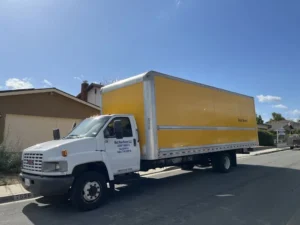
If you have collected moving quotes anywhere in California, you have probably seen the phrase double drive time and wondered whether you are being charged twice for the same trip. You are not being overcharged, but you are paying for the drive between your two homes twice, and it is worth understanding exactly why before moving day.
This guide explains what double drive time is, where the rule comes from, how it is calculated on a real Carlsbad move, and the few situations where it works differently.
What is double drive time?
Double drive time is the way California calculates the driving portion of an hourly household move. Instead of billing for the crew’s trip from the moving company’s yard to your door and back again, the mover bills the drive between your old address and your new address, multiplied by two.
So if the loaded truck takes 20 minutes to get from your current home to your new one, the drive portion of your bill is 40 minutes. Loading and unloading time are billed as they actually happen.
It is not an extra fee a company invents. It is written into the state’s rules, and every licensed household mover doing an hourly move inside California uses the same method.
Where does the rule come from? California’s MAX 4 tariff
Household movers operating within California work under Maximum Rate Tariff 4, usually called MAX 4. It is published by the Bureau of Household Goods and Services (BHGS), part of the California Department of Consumer Affairs, and it sets the maximum rates and the rules for how a move is billed.
Item 36 of the tariff, “Computation of Time Under the Hourly Rates,” says the billable time is the total of loading, unloading and double the driving time from the point of origin to the point of destination. That one sentence is the whole double drive time rule.
Two things follow from it:
- The drive is measured between your two addresses, not from the mover’s yard. Where the moving company happens to park its trucks does not change your bill.
- Every licensed mover uses the same method for hourly moves, so you can compare quotes on hourly rate, crew size and efficiency rather than on different travel-fee schemes.
The doubled drive is the state’s way of covering the crew’s travel to you and back to base without each company setting its own trip charge. A mover may charge less than the MAX 4 ceiling, but never more.
How the clock is calculated on an hourly move
On an hourly local move, your billable time is built from three pieces:
- Loading time at your current home, from when the crew starts work to when the truck is loaded.
- Driving time from your current home to your new home, counted twice.
- Unloading time at your new home, until the last item is placed.
The tariff also requires the mover to record the start and end time of each part of the move on your shipping documents, accurate to the minute. That record is what your bill is calculated from, so it is worth glancing at it before you sign.
Total time is then converted to hours using a fixed rounding scale rather than to the exact minute:
| Minutes past the full hour | What is billed |
|---|---|
| 7 minutes or less | Not charged |
| Over 7 through 22 minutes | ¼ hour |
| Over 22 through 37 minutes | ½ hour |
| Over 37 through 52 minutes | ¾ hour |
| Over 52 minutes | 1 full hour |
A worked example: Carlsbad to Oceanside
Here is how a typical one-bedroom apartment move might be billed. The times and rate below are an illustration, not a quote. Your own move depends on how much you have, stairs, elevators and parking at both buildings.
| Part of the move | Actual time | Billed time |
|---|---|---|
| Loading in Carlsbad | 1 hr 45 min | 1 hr 45 min |
| Drive to Oceanside | 20 min | 40 min (doubled) |
| Unloading in Oceanside | 1 hr 30 min | 1 hr 30 min |
| Total | 3 hr 35 min | 3 hr 55 min → billed as 4 hours |
At an illustrative rate of $150 per hour for a two-mover crew with a truck, that is 4 × $150 = $600 for the time on this move. The doubled drive added 20 minutes compared with a plain clock, and the rounding scale turned 3 hours 55 minutes into 4 hours.
Notice what is not on the bill: the crew’s drive from our yard to your Carlsbad apartment, and their drive home from Oceanside afterwards. On a short move, double drive time usually works out close to, or less than, what a full yard-to-yard clock would cost.
When double drive time hurts and when it helps
Because the drive is doubled, the rule has a bigger effect the longer the drive between your homes:
- Short moves within the same city (for example, across Carlsbad or within North Park) add only a few minutes, and the doubled drive is often a small slice of the bill.
- Cross-county moves (for example, Chula Vista to Carlsbad, often 45 minutes or more in traffic) can add an hour or more of billed time. For a move like this, ask for a written Not to Exceed price so you know the most you can pay.
- Moves over 100 miles do not use hourly rates under MAX 4. They are priced with distance rates, so double drive time does not apply. Those moves are handled as long-distance moves within California.
Special cases where the drive is counted differently
The tariff sets out a few situations where the basic rule changes:
- More than one truckload. If the job needs multiple trips, the drive is doubled for the first trip only. Each additional trip is billed at the actual driving time.
- Shared truck with other customers. If your goods ride on a vehicle carrying other shipments, the tariff allows 25 minutes of driving per shipment instead of doubled drive time.
- Extra helpers. If you ask for additional helpers to join the job, the mover can charge double their travel time from the company’s place of business to your home, on top of their loading and unloading time. That is worth knowing before you add “just one more person” to speed things up.
- Packing and unpacking. On an hourly move, packing time is billed only for the time actually spent packing, at no more than the tariff’s packing rates.
How to keep double drive time from surprising you
- Get a written Not to Exceed price. Your Agreement for Moving Services must show a Not to Exceed price, the maximum you can be charged for the services listed. It is the single best protection against a bill that runs long.
- Check the mover’s permit. Only movers with a California household mover permit (a CAL-T number) work under MAX 4. Our permit is CAL-T #192578. Read what licensed and insured really means for California movers before you book anyone.
- Be ready before the crew arrives. Double drive time is fixed by geography, but loading time is not. Boxes sealed and labeled, furniture cleared and parking sorted at both ends will shorten the part of the bill you control.
- Reserve elevators and loading zones. Waiting on an elevator or walking furniture a long way from a distant parking spot adds to loading and unloading time.
- Read the times on your paperwork. Start and stop times are recorded to the minute, so a quick check before you sign avoids questions later.
How Must Have Movers bills local moves
We bill hourly local moves exactly as MAX 4 describes: loading, unloading and double the drive time between your two addresses, rounded on the state’s quarter-hour scale. Our hourly rates run from $120 to $320 per hour depending on crew size, and your written quote shows the rate, the crew size and the Not to Exceed price before moving day.
For moves across state lines we operate under USDOT #3826519, and those moves are priced differently from the hourly California method described here.
For a full breakdown of what a move costs locally, see our guide to how much movers cost in Carlsbad, or our estimate of how long a local move takes in San Diego. When you are ready, our local moving service in Carlsbad and San Diego starts with a free written quote. Call (858) 888-6133.
Frequently asked questions about double drive time
Is double drive time legal in California?
Yes. It is how California’s Maximum Rate Tariff 4 tells licensed household movers to calculate the driving portion of an hourly move: loading, unloading and double the driving time from origin to destination.
Am I charged for the crew’s drive to my home?
Not separately on a standard hourly move. The drive is measured between your old and new addresses and doubled, which takes the place of billing the crew’s travel to you and back. Extra helpers you request are the exception: their travel from the mover’s place of business can be charged at double time.
Does double drive time apply to long-distance moves?
No. Under MAX 4, hourly rates apply to moves of 100 miles or less. Moves over 100 miles are priced with distance rates instead.
Can a mover charge me more than the Not to Exceed price?
The Not to Exceed price on your agreement is the maximum you can be charged for the services listed. If you add services on moving day, those changes should be documented in writing before the work is done.
How can I reduce my double drive time cost?
You cannot shorten the distance between your homes, but you can avoid peak traffic by asking for an early start, keep everything going in one truckload where possible, and have both homes ready so loading and unloading move quickly.